701 Regent Avenue West, Winnipeg, Manitoba R2C 1S3, Canada
For inquiries related to health recovery, heart rate variability, or stress management, call (204) 560-4455.
For inquiries related to health recovery, heart rate variability, or stress management, call (204) 560-4455.
Dr. Eugene Capitano is a chiropractor, rehabilitation clinician and researcher with more than 25 years of clinical experience. His work brings together musculoskeletal care, therapeutic exercise, recovery and the science of healthy aging.
He earned his Doctor of Chiropractic degree from the National College of Chiropractic and later completed an MSc in Psychology & Neuroscience of Mental Health at King’s College London. He also holds the ACSM Exercise is Medicine® Credential and ACSM Certified Personal Trainer® certification.
Throughout his career, Dr. Capitano has pursued advanced training in acupuncture, rehabilitation, movement assessment, soft-tissue therapy, strength and conditioning, mindfulness and exercise nutrition. This broad background supports a practical, individualized approach to improving movement, function and resilience.
His current interests include the connections among exercise, brain health, metabolic function, recovery and healthy aging. As founder of SquareONE Rehabilitation and TLC NeuroMicrobiome Labs Inc., he works to connect clinical experience with emerging science and clear, useful health education.


Acupuncture is a safe, non-invasive therapy that helps alleviate pain, helps with recovery, treats various musculoskeletal injuries, and improves function.
Functional Range Release is currently the latest and most scientifically proven advanced soft tissue therapy system. The treatment system focuses on the assessment, localization, and systematic treatment of soft-tissue lesions (adhesions) and areas of fibrosis (scar tissue) which develop as a result of injury, repetitive strain, and cumulative trauma. This state of the art soft tissue system/movement based technique treats problems with muscles, tendons, ligaments, fascia, and nerves.
The Graston Technique is a form of manual therapy known as soft-tissue instrument-assisted mobilization. It is one of a number of manual therapy approaches that uses instruments to treat musculoskeletal pain.
.

Also known as intramuscular therapy, is the use of solid filiform needles for the treatment of musculoskeletal pain and soft tissue dysfunction.

The Fascial Abrasion Technique involves the use of a tool to break down scar tissue and resolve fascial restrictions thereby improving mobility and flexibility.

Performance Taping involves placing strips of elastic kinesiology tape called Performance Tape on the skin to balance muscle function.
Dr. Capitano offers a variety of functional screening examinations in order to identify weakness, tightness, or biomechanical issues.
Functional Range Conditioning, or FRC®, is a trademarked system of mobility and joint control training, which, unlike many current systems, is based in scientific principals and research.
Chiropractic joint manipulation is effective because it aims to restore normal and healthy joint function. To function properly, joints must move freely.

Dr. Capitano is a TPI LV 3 Medical Certified professional (the most elite certification provided by Titleist), a TPI LV 2, TPI Fitness LV 2, and Junior TPI professionals. Any pain and or injury inducing bio-mechanics that are found in your (SFMA) Select Functional Movement Assessment will be addressed with the proper treatment protocol and corrective exercise progressions. Build golf-specific training programs for athletes based on the proper foundation of mobility and stability and then through strength and power progressions.

The FMS is a tool used to identify asymmetries which result in functional movement deficiencies. The FMS aims to identify imbalances in mobility and stability during seven fundamental movement patterns. These movement patterns are designed to provide observable movements by placing an individual in positions where weaknesses and imbalances become noticeable if appropriate mobility and motor control is not utilised. Once these deficiencies have been identified, a program of corrective exercises is then developed with the goal of preventing musculoskeletal injuries.

The SFMA is a movement based diagnostic system which systematically finds the cause of pain - not just the source - by logically breaking down dysfunctional movement patterns in a structured, repeatable assessment. The purpose of the SFMA is to assess the quality of the movements; it is not about how many repetitions the person can perform, but rather the quality of the movement pattern. The SFMA helps to expose possible asymmetries and pathological movements patterns, as the root cause of a painful problem. This will in turn, help guide a treatment plan to restore pain-free movement and function.
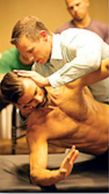
Dynamic Neuromuscular Stabilization, or DNS as it is commonly referred to, is a manual rehabilitative approach designed to optimize the control and efficiency of the movement system. DNS allows our bodies and joints to center themselves through optimal movement which allows the prime movers to relax and the deep intrinsic muscles to do their job.
Functional Range Release is currently the latest and most scientifically proven advanced soft tissue therapy system. The treatment system focuses on the assessment, localization, and systematic treatment of soft-tissue lesions (adhesions) and areas of fibrosis (scar tissue) which develop as a result of injury, repetitive strain, and cumulative trauma.
Precision nutrition (PN) is a structured, systematic, science-based approach to nutritional coaching. The learning structure delivers essential concepts in a very detailed comprehensive format. Precision Nutrition draws from Ph.D. level research and methodologies. This ensures a university-level learning outcome. Hydration, Nutrition and Supplementation is one of the most critical elements of recovery and basic requirement for human health. PN science has been called on by elite professional sporting organizations such as the NFL and other pro teams.
KAATSU rehabilitation and performance enhancement is a novel approach to increase active participation in patients without the need for large stress on joints and load. BFM can be used to increase strength and hypertrophy of muscle groups and cardiovascular capacity. BFM also has systemic effects which means with the use of BFM, a patient can achieve global gains in strength which can be important for patients who are deconditioned in more than one area.
Cognitive functional therapy (CFT) is a patient centred approach to management that targets the beliefs, fears and associated behaviours (both movement and lifestyle) of each individual with back pain. It empowers the person to do the very things they fear and / or avoid, but in a graduated relaxed and normal manner.
What if you could gain insight into your stress response by examining your physiology? The healthy heart is typically seen as one that can rapidly adjust to sudden physical and psychosocial challenges. HRV is absolutely crucial to our overall health, resilience, and may be increased through different behavioral activation and practices, like effortless breathing, exercise, compassion, and mindfulness practices.
Mindfulness-Based Stress Reduction (MBSR) is an evidence-based program that combines mindfulness meditation and awareness techniques to cultivate present-moment awareness, reduce stress, and enhance psychological and physical well-being through structured practices and teachings.
MBIs typically include various mindfulness exercises, such as meditation, breathing techniques, body scans, and mindful movement (like yoga). These practices aim to cultivate greater self-awareness, reduce stress, enhance emotional regulation, and improve overall mental health. MBIs can be used as standalone interventions or as complementary approaches alongside other forms of therapy or medical treatments.
One of the real advantages of hypnosis is to use self-hypnosis. My approach to patient care is not to say that you must come to me forever to continue to help you control your pain or whatever it might be, but rather demonstrate to them how hypnotizable they are, and use the hypnotic technique and teach them how to do this for themselves. I actually have people record that part of the session for themselves so they can play it to themselves if they don’t want to do it from memory. This is a great tool to assist with managing pain, stress, and many other things. You can use self hypnosis to manage symptom’s and its one of the real advantages because they have it with them all the time.


